Performance of Various Geosynthetic-Reinforced Embankment and Foundation Systems Subjected to Reverse Fault Movement
Performance of Various Geosynthetic-Reinforced Embankment and Foundation Systems Subjected to Reverse Fault Movement
Department of Civil Engineering Research Achievement Share by Assistant Professor Jung Chiang
Journal of Geotechnical and Geoenvironmental Engineering (https://ascelibrary.org/doi/10.1061/JGGEFK.GTENG-12785)
Surface deformations induced by fault movements often lead to structural failures in linear infrastructure such as bridges, embankments, and tunnels—as seen during the 1999 Chi-Chi earthquake, where the Chelungpu fault movement caused the collapse of the Shihkang Dam and Pifeng Bridge. A geosynthetic-reinforced soil foundation increases the shear strength of backfill soil through frictional resistance at the soil-geosynthetic interface, preventing the development of shear ruptures. Leveraging the tensile properties of geosynthetics, it provides vertical uplift force during fault movement, dispersing the shear rupture into a wider influence zone and mitigating angular distortion to reduce disaster potential—a phenomenon known as the tension membrane effect. However, while existing studies indicate that geosynthetic-reinforced foundations can mitigate the impact of fault movement on surface deformation, understanding of their efficacy and underlying mechanisms remains limited. Furthermore, the tension membrane effect of geosynthetics may not fully develop during reverse fault movements; thus, studying the behavior of reinforced foundations subjected to reverse faulting is essential.1999(Geosynthetic-reinforced soil foundation)-(Shear rupture)(Influnce zone)(Angular distortion)(Tension membrane effect)
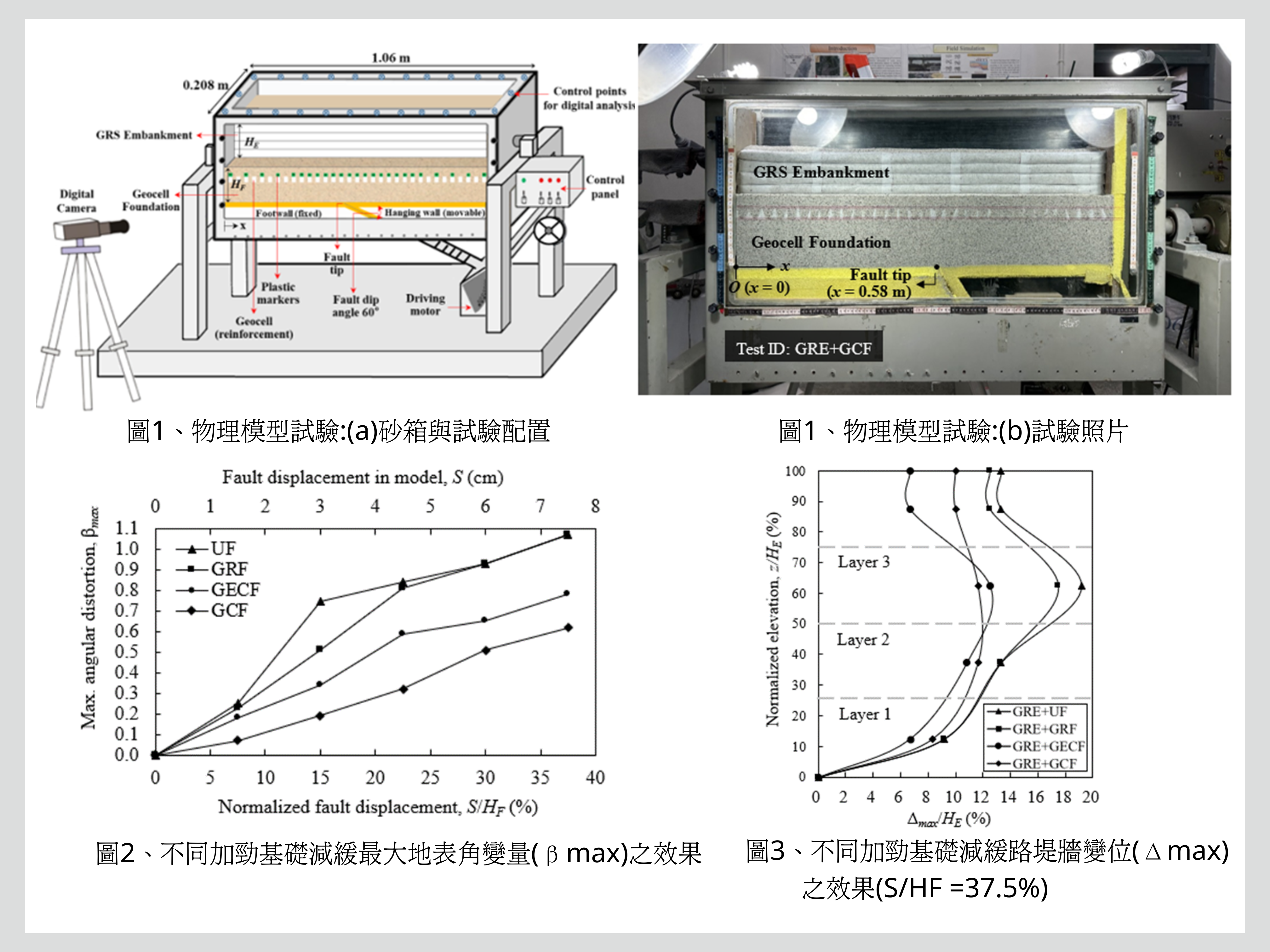
This study utilized a sandbox (Figure 1) to conduct physical model tests, employing digital image analysis to examine the mechanism and effectiveness of geosynthetic-reinforced foundations in resisting reverse fault movement. Analyzed parameters included maximum angular distortion ($\beta_{\max}$) and shear strain contours induced by reverse fault movement. The overall stability of the reinforced embankment-foundation system under reverse faulting was evaluated via the maximum wall displacement ($\Delta_{\max}$) of the reinforced embankment. Three types of reinforced foundations were investigated:(1)(Physical model test)(Digital image analysis)(Maximum angular distortion, βmax)(Shear strain contour)(Maximum wall displacement, Δmax)(1)1. Planar geotextile(Planar geotextile)、(2)2. Geocell(Geocell)(3)3. Geosynthetic encased granular columns (GECs)(Geosynthetic encased granular columns, GECs)These were compared against an unreinforced foundation.(Unreinforced foundation)
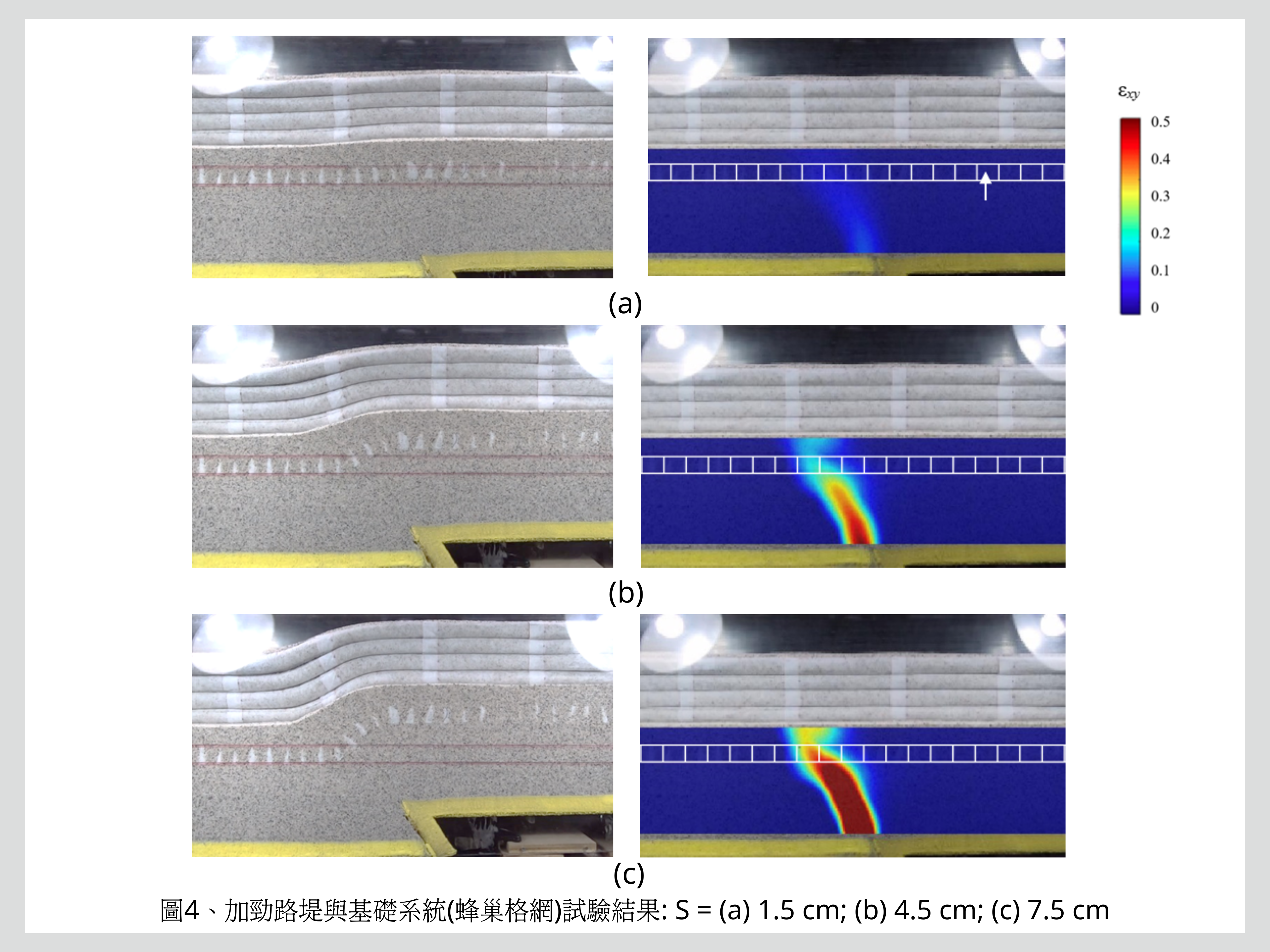
Experimental results demonstrate that different reinforcement types exhibit distinct performance and mechanical mechanisms. Figures 2 and 3 compare the effectiveness of different reinforcement types in mitigating $\beta_{\max}$ and $\Delta_{\max}$, respectively. The geocell foundation achieved the best results in mitigating both $\beta_{\max}$ and $\Delta_{\max}$. When the ratio of reverse fault displacement ($S$) to foundation thickness ($H_F$) reached $S/H_F = 37.5\%$, $\Delta_{\max}$ was reduced by $39.1\%$, and the wrapped-around facing suffered no damage (Figure 4). The primary reason is that 3D geocells provide confinement stress, enhancing soil shear strength and blocking the shear rupture from propagating to the ground surface. Geosynthetic encased granular columns (GECs) also effectively reduced $\beta_{\max}$ and $\Delta_{\max}$ through the encasement effect of the geosynthetic, which increased the soil's shear and bending resistance while blocking and dispersing the shear rupture into a wider influence zone. In contrast, planar geotextile foundations showed limited effectiveness because planar geosynthetics (geogrids) cannot develop a strong tension membrane effect during reverse faulting, resulting in more pronounced surface angular distortion. Additionally, this study investigated the impact of embankment overburden stress on the mechanisms of reinforced foundations and proposed design recommendations for reinforced embankment-foundation systems against reverse fault movements.