Semantic Digital Thread Framework for Explainable Lifecycle Carbon Management: An Ontology-Driven and Auditable Automation Backbone
Semantic Digital Thread Framework for Explainable Lifecycle Carbon Management: An Ontology-Driven and Auditable Automation Backbone.
Research Sharing by Assistant Professor Chien-Pu Huang, Department of Civil Engineering
Automation in Construction.((https://doi.org/10.1016/j.autcon.2026.107026)
Buildings account for approximately 40% of global energy-related carbon emissions, making building carbon reduction a crucial subject in the net-zero transition. Although Life Cycle Assessment (LCA) standards such as BS EN 15978 and ISO 14040 define "what should be measured," they do not specify how heterogeneous data across BIM, IoT, and LCA should be connected, validated, and automated. In practice, BIM models, energy monitoring platforms, and carbon accounting tools remain isolated, leading to inconsistent data interpretation and heavy reliance on manual processing. Existing ontologies, while capable of describing domain knowledge, mostly remain at the "representation" layer and cannot directly drive reasoning and automated workflows. Furthermore, carbon emissions and ESG reports often lack end-to-end traceability from data sources and reasoning rules to triggered actions. This study defines this phenomenon as the Semantic-Execution Gap ($G_{se}$) and formalizes it into a measurable and verifiable construct, arguing that lifecycle carbon management requires more than data representation—it demands a mechanism that can reliably translate semantic intent into auditable actions.
This study proposes the Semantic Digital Thread (SDT) framework, adopting an "Ontology-as-Infrastructure" methodological stance to transform ontologies from passive data dictionaries into active execution infrastructure. The framework operates in four steps: 1. TBox Construction: Integrates BS EN 15978 lifecycle modules, IFC building components, and SOSA/SSN sensor observations to establish a standards-aligned ontology backbone (TBox) ; 2. ABox Instantiation: Instantiates BIM, IoT, and LCA data into a Neo4j knowledge graph (ABox) via Python ETL; 3. Graph-Native Reasoning: Executes Cypher/APOC graph-native reasoning to detect energy anomalies and carbon intensity overruns, automatically triggering alerts, maintenance work orders, and other workflows through n8n.; 4. Decision Provenance: Embeds the Entity, Activity, and Agent structures of W3C PROV-O directly into the graph, making every decision fully traceable. Together, these form a closed-loop architecture consisting of a semantic layer, an automation layer, and a governance layer. The Python ETL, Neo4j, and n8n services are containerized using Docker to ensure reproducible system deployment (Figure 1). Using multiple buildings on the NTU campus as a testbed, the framework was evaluated across governance, modularity, reasoning-to-action, and provenance through six technical highlights (TH1–TH6; Figure 2). Results show that the ontology alignment achieved 92% mapping coverage, and the accuracy rate for heterogeneous data instances reached 98%. In reasoning-to-action benchmarks, anomaly detection achieved a precision of 95.0% and a recall of 90.0%, with end-to-end reasoning latency reduced by approximately 60% compared to traditional SQL and Python pipelines. Reconstruction completeness for decision provenance exceeded 99%, AI-assisted data ingestion reduced expert revision time by about 60%, and Docker containerized deployment enabled one-click environment reconstruction within approximately 3 minutes. The study also releases a reproducible dataset and a complete rule base, clarifying the boundary of applicability for graph-database-based digital twins.
This research advances building carbon management from "post-hoc auditing" to "traceable and auditable decision execution". Looking forward, it can be extended to public works carbon governance and critical infrastructure operations, ensuring that every AI-assisted decision stands up to scrutiny and remains trustworthy.
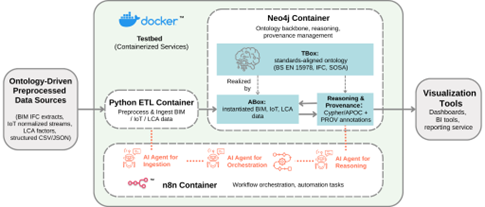
Figure 1: SDT Containerized System Architecture: Integrated Operation of Python ETL, Neo4j, and n8n (Source: Huang & Hsieh (2026), Automation in Construction, Fig.5)
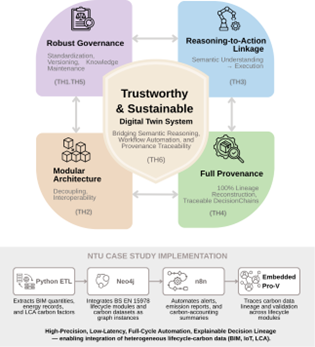
Figure 2: SDT Core Design Principles and Implementation in the NTU Campus Case Study (Source: Huang & Hsieh (2026), Automation in Construction, Fig.14)