Ultralow energy consumption conjugated polymers with perovskite quantum dots via polarity adjustment for photosynaptic transistors
Ultralow energy consumption conjugated polymers with perovskite quantum dots via polarity adjustment for photosynaptic transistors.
By Assistant Professor Wei-Cheng Chen of Department of Molecular Science and Engineering
With the rapid development of artificial intelligence, smart sensing, and low-power computing, overcoming the energy bottleneck of the conventional von Neumann architecture has become a critical challenge for next-generation electronics. Inspired by the human brain, where synaptic signal transmission and memory processing can be achieved with extremely low energy consumption, photosynaptic transistors have emerged as promising candidates for future edge computing, intelligent vision systems, and neuromorphic electronics. However, achieving high sensitivity, low power consumption, and stable operation in such devices strongly depends on the rational design of heterojunction materials, particularly the efficient separation, transfer, and trapping of photogenerated carriers at the interface (Figure 1). In this work, we developed a new material design strategy by modulating the polarity of perovskite quantum dots (PeQDs) through tin (Sn) doping. This approach allows the trapping behavior of electrons and holes in conjugated polymers (CPs)/PeQDs nanocomposites to be tuned and matched with different types of conjugated polymers (Figure 2). Our results show that appropriate Sn doping effectively adjusts the optoelectronic properties, energy levels, and bipolarity of PeQDs. At the same time, it improves defect passivation, enhances photoluminescence quantum yield, and optimizes interfacial compatibility within the hybrid system. As a result, Sn-doped PeQDs exhibit distinct polarity-matching behavior when integrated with p-type and n-type CPs. In particular, in p-type systems, Sn–PeQDs promote more efficient electron trapping and prolong carrier release, which is highly beneficial for enhancing synaptic memory and photonic signal retention. In contrast, different responses are observed in n-type systems, further confirming that polarity engineering of PeQDs plays a decisive role in governing heterojunction performance. To demonstrate device applications, Sn–PeQDs were integrated with the p-type conjugated polymer DPPSe to fabricate high-performance photosynaptic transistors. These devices successfully emulated key biological synaptic functions, including short-term plasticity, long-term plasticity, spike-number-dependent plasticity, and spike-time-dependent plasticity. Such behaviors indicate that the device can not only respond to external optical stimuli, but also accumulate, retain, and process information in a way analogous to biological synapses. More importantly, by precisely tailoring polarity compatibility and interfacial charge trapping, the optimized device achieved an ultralow energy consumption of only 0.169 aJ per synaptic event under very low operating conditions. This value outperforms most previously reported p-type optoelectronic synaptic devices and highlights the great potential of this material platform for ultralow-power neuromorphic electronics. Beyond device-level characterization, this study further validated the application potential of the proposed system through artificial neural network (ANN) simulations for image denoising and pattern recognition. By incorporating the device characteristics into a denoising array and ANN framework, the recognition accuracy for handwritten digit images was improved to approximately 90% (Figure 3). These results demonstrate that the present work is not only innovative in terms of material design and device engineering, but also highly promising for future applications in intelligent sensing, visual information processing, and energy-efficient AI hardware. Overall, this study establishes a complete research framework spanning materials polarity tuning, heterojunction design, charge-trapping mechanism, and neuromorphic application verification, providing valuable guidelines for the development of next-generation soft optoelectronic and low-power neuromorphic devices.
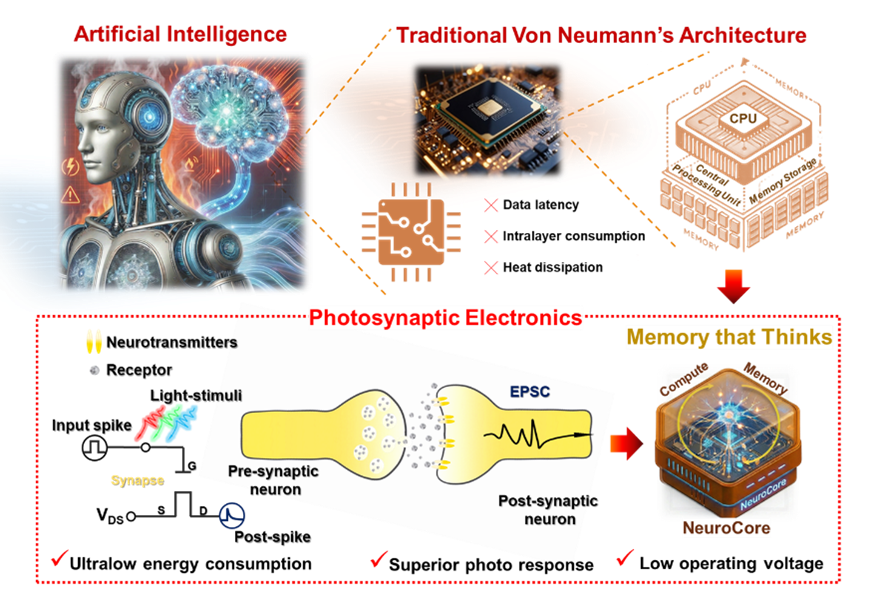
Fig.1. Schematic comparison between the conventional von Neumann architecture and the photosynaptic transistor architecture..
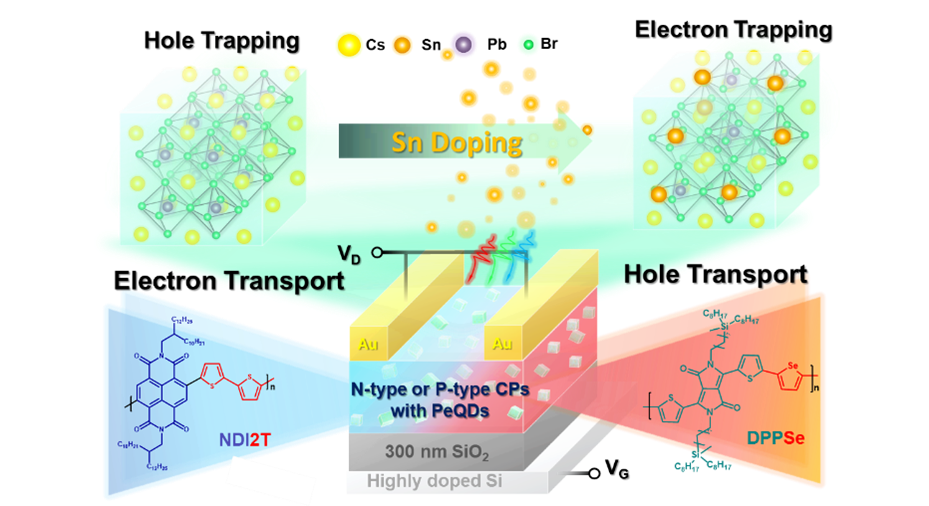
Fig.2.Schematic illustration of polarity tuning in PeQDs through Sn doping, which provides distinct carrier-trapping characteristics and enables their integration with different types of conjugated polymers.

Fig.3.(a), (b) Demonstration of synaptic plasticity behaviors; (c) Comparison of minimum energy consumption; (d) Schematic illustration of the denoising array and handwritten digit recognition; (e) Artificial neural network (ANN) architecture; (f) Verification of learning and recognition accuracy.